Pakistan Army - Men at their Best

The story of the advancement of Pakistan Army is the tale of the birth of Pakistan, since its inception from the freckled nucleus of a regal legacy to its present status of an avant-garde and combat-tested field Army; it is an epoch of development which leaves behind its trials and tribulations, calamities and conflicts, as it struggled, with scarcity of possessions to embark on its shaping years. This is, conceivably, the enormous paradigm amongst few armies in history to have faced a war right at its setting up and, in the subsequent years, besides guarding the geographical precincts, it is always prepared to protect the ideological boundaries of the country.

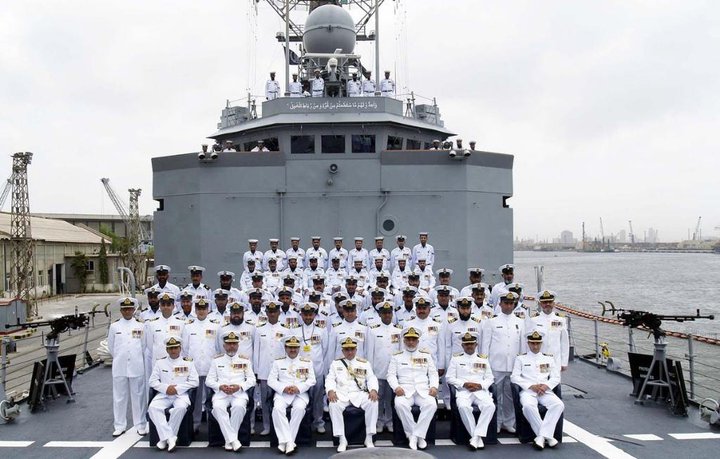
Pakistan Navy - A Silent Force to Reckon with

The birth of Royal Pakistan Navy came with the creation of Pakistan on the historic day of 14 August 1947. Like other navies of the commonwealth, Pakistan’s Navy also had the prefix “Royal” until the country was proclaimed a republic in 1956. At 0800 on 14 August 1947, the flag of Rear Admiral J W Jefford, Flag Officer Commanding Royal Pakistan Navy was hosted on his Flagship HMPS GODAVARI. The Admiral’s first signal addressed to the officers and men of the RPN was flashed to all ships and shore establishments.

Pakistan Air Force - A symbol of pride for the nation

PAF was born on 14th of August 1947, with the independence of Pakistan. The growth of PAF is a story of unusual struggle and sacrifice. A tiny auxiliary Service, with a small number of personnel and insignificant equipment, emerging as a powerful weapon of the country’s defence, was a thrilling phenomenon. The dedication of its pioneers shaped the future of a force, destined to gain respect, after proving its worth in the wars of 1965 and 1971, where it outclassed a much larger enemy, India. The story of PAF is a tale of development, despite heavy odds and limitations. It is the narration of a nation’s desire, for preserving its freedom, through the use of technology and willpower, working side by side.

Thursday, July 21, 2011

Pak-China navies celebrate 60th anniversary of friendship

July 21st, 2011: About 500 officers and staff of the Pakistan Navy celebrated the 60th anniversary of Pakistan-China friendship at a reception held on Wednesday Evening.
The reception was arranged at the deck of 3000-tonne Chinese made Ship Shamsheer at Qingdao naval port.

Speaking on the occasion Mission Commander, Commodore Amjad Niazi said that Pakistan Navy deeply values the support provided by Peoples Liberation Army (PLA) Navy and expressed the confidence that the lasting association between the two navies would be taken to new heights in future.

Rear Admiral Sun De Zhong, Deputy Commander North Sea Fleet, congratulated the ship formation on this visit, which he said, has further strengthened the ties between the two nations.

The reception was attended by North Sea Fleet Commander, Vice Admiral Tian Zhong; Chief of Staff of Pakistan Navy, Vice Admiral Asif Sandila; officers of the PLA Navy, defence attaches of various countries and officials of the Pakistan Embassy.

Two Pakistan Navy ships, PNS Shamsheer and PNS Nasr arrived at Qingdao port on the morning of 19th July after a journey of 30 days to join the celebrations.

Qingdao, the capital of Shandong province, is a major seaport, naval base and industrial centre of eastern China.

Wednesday, July 20, 2011

Pakistan Navy inducts first squadron of Unmanned Aerial Vehicles (UAV) UQAB-II

July 20th, 2011: In pursuit of policy of self reliance and indigenization being undertaken by Pakistan Navy, the first squadron of Unmanned Aerial Vehicles (UAVs) has been formally inducted in Pakistan Navy Fleet during a ceremony held at PN Aviation Base, Mehran. Chief of the Naval Staff, Admiral Noman Bashir, was the chief guest on the occasion.

The indigenously developed UAVs are equipped with state of the art equipment and sensors and can successfully be employed in support of Maritime Interdiction Operation (MIO) in the coastal areas. The induction of UAVs in Pakistan Navy will enhance the operational capabilities of PN.


The Chief of the Naval Staff while addressing the audience, congratulated all those who were involved in the UQAB-II programme and expressed satisfaction on induction of UAVs.

He said that prevailing maritime environment poses multifarious challenges to navies across the globe. In addition to traditional roles, navies are now increasingly confronted with emerging challenge of deterring maritime terrorism. Owing to their small size, ease of operation and maintenance versatility in employment and low risk of loss, UAVs today are regarded as force multipliers and are increasingly being used by combat forces worldwide.

The Chief of the Naval Staff reiterated that UAVs induction is a manifestation of PN's commitment and resolve towards self reliance and indigenization. Cognizant of the heightened surveillance measures at all times, the induction of UQAB-II UAVs will provide essential experience to Pakistan Navy and necessary impetus to utilize this particular segment of warfare to the best use of naval objectives.


Two STUS, frigate Alamgir join PN fleet

July 19th, 2011: PN Ships MADADGAR and RASA-DGAR; the small Tanker Cum Utility Ships (STUS) have been commissioned and PNS ALAMGIR formally inducted in Pakistan Navy Fleet during an impressive ceremony held at Pakistan Navy Dockyard on 19 Jul 11. Chief of the Naval Staff, Admiral Noman Bashir graced the occasion as chief guest. The ceremony was attended by officials from Ministry of Defence (MoD), Flag Officers from Pakistan Navy, senior management of Karachi Shipyard and Engineering Works (KS&EW) and other distinguished guests.

PN Ships RASADGAR and MADADGAR; the first ships of their class, have been indigenously constructed in Pakistan by Karachi Shipyard & Engineering Works. Induction of STUS will increase logistic redundancy to Pakistan Navy Fleet. These state of the art crafts are designed and equipped for multi facet roles with robust and reliable modern machinery and equipment.


Thursday, July 14, 2011

National Command Authority (NCA) met today

July 14th, 2011: The National Command Authority (NCA) met today under the Chairmanship of Prime Minister Syed Yusuf Raza Gilani. Members of the NCA including Federal Ministers, Chairman Joint Chiefs of Staff Committee, Services Chiefs, Secretary NCA DG SPD, and other senior officials attended the meeting.

The NCA comprehensively reviewed developments in the regional and global security environment. The NCA also undertook detailed appraisal of the international and regional trends and policies and their implications for Pakistan.

After in-depth consideration and evaluation, the National Command Authority, inter alia, decided that Pakistan will continue to pursue its policy of Credible Minimum Deterrence as a responsible nuclear weapons state. The NCA expressed satisfaction at the security and safety of Pakistan’s strategic programmes and facilities. It also expressed confidence in the operational readiness of Pakistan’s strategic weapons.
The NCA expressed concern over the continued pursuit of policies that detract from the globally shared norms and rules of equality, inclusiveness and objectivity. The NCA cautioned that such policies represent regression in the non-proliferation regime and tend to erode the strategic balance in South Asia. Pakistan would continue to take appropriate counter measures to ensure its security and to maintain regional stability.

The National Command Authority reiterated Pakistan’s desire to constructively contribute to the realization of a world free of nuclear weapons and to the goals of non-proliferation on the basis of equality and partnership with the international community. Accordingly, Pakistan was keen to join the four export control arrangements.

The NCA reaffirmed the importance of nuclear safety. In this regard, it noted with satisfaction the safety review of all the existing and planned civil nuclear facilities by the Pakistan Nuclear Regulatory Authority (PNRA). The NCA directed the PNRA and the Pakistan Atomic Energy Commission (PAEC) to continue to ensure that our programmes conform to the highest levels of safety and international best practices.
The NCA was also briefed on the nuclear security review undertaken recently. It expressed confidence in the institutionalized Command and Control System and comprehensive measures put in place to ensure reliability and security of strategic assets. The NCA underlined that the Government and the people of Pakistan stood solidly behind the country’s nuclear and missile programmes, which would be pursued to maintain effective, reliable and credible deterrence capability, and all attempts to undermine this capability would be thwarted with full force.

As part of the energy security strategy, the NCA also reviewed and approved the futuristic, self-sustaining Nuclear Power Programme – 2050, to meet the existing energy shortfalls and to respond to the future requirements of a growing population and economy. The NCA emphasized the need to focus on socio-economic development of the people as a foremost priority.

The NCA also approved Pakistan’s Space Programme – 2040 in order to bring the benefits of the full spectrum of space technology to the people of Pakistan.

Wednesday, July 13, 2011

COAS, General Kayani visits troops at WALI DAD, MOHMAND AGENCY

July 13th, 2011: Chief of Army Staff (COAS), General Ashfaq Parvez Kayani paid rich tributes to the officers and soldiers who laid down their lives while fighting against terrorists in Mohmand Agency. He was addressing the troops at Wali Dad Top, near Pak-Afghan border during his visit to Mohmand Agency.

COAS attributed the success to the outstanding combat skills and high morale of the armed forces and FC. He also praised the joint operations of Pakistan Army and PAF for the clearance of Suran Sector.

General Kayani also met the Mishrans (notables) of Mohmand Agency and thanked them for their whole hearted support to the military operations. He emphasized the need for the Tribes to take full responsibility and effective control for ensuring sustainable peace in their area. He directed the military and civil authorities to extend all possible support to the returning IDPs.
Malik Subedar Safi, the representative of local Mishrans thanked the COAS and acknowledged the sacrifices of the Army in flushing out the terrorists. Mishrans also appreciated the efforts of Political Agent in restoring the old system of tribal administration as per their Riwaj.

COAS was informed that over 1500 terrorists have surrendered to the Political Agent and are being dealt in accordance with the FCR. Troops also destroyed seven factories of IEDs in the area. During the Mohmand operations, 69 officers and soldiers embraced shahadat and 231 were injured (including 41 critical injuries).

COAS was accompanied by Corps Commander Peshawar, Lieutenant General Asif Yasin Malik and IGFC Major General Nadir Zeb.

KSEW starts constructing Fast Attack Craft (Missile) for Pakistan Navy

July 12th, 2011: The steel cutting ceremony of the Fast Attack Craft (Missile) FAC (M) for Pakistan Navy was held at the Karachi Shipyard and Engineering Works (KSEW) on Tuesday. The Secretary of Defence Production, Lt. Gen. (Retd) Shahid Iqbal, was the chief guest at the ceremony and performed the steel plate cutting ceremony.

The FAC would be constructed at the KSEW with the technical assistance from China. Speaking on the occasion, Gen (Retd) Shahid Iqbal felicitated the KSEW in general and the ship building team in particular for achieving the first milestone smoothly. He said that it was a matter of satisfaction that assistance is being provided by the time tested friend China on whose support Pakistan has always relied in many strategic areas.

The Secretary Defence Production was sure that KSEW, Pakistan Navy and the Chinese will work hand in hand in future endeavours also with the same spirit and cooperation and deliver the FAC as per the schedule. He stated that KSEW is an important commercial component of the ministry of Defence Production and ‘with every event like the one today we feel event more confident that Karachi Shipyard will address all the requirements of not only for the Pakistan Navy, rather other public organizations like in the maritime sector like MSA, KPT, PNSC and Gwadar Port etc and also earn valuable foreign exchange’.

Gen. (Retd) Shahid Iqbal assured that the Ministry of Defence Production will support KSEW management in all its plans for modernization and expansion. “Together we will ensure that Pakistan becomes a leading ship building country in the region in line with its potential and ideal strategic location,” he maintained. In his welcome address, Managing Director of KSEW, Commodore Sajid Wazir, said KSEW was taking this project as a challenge and an opportunity to change the perception of the institution and establish that the Shipyard was fully capable, ready and committed to undertake challenging tasks while ensuring the highest standards of quality.


Tuesday, March 29, 2011

Auditor slams Indian Navy

India’s state auditor has criticised the modernisation of the country’s navy, warning that delays and ballooning costs in its shipyards are severely diminishing its fighting capacity, reports ‘Financial Times’.The official auditor warned that India’s maritime power was falling because of poor performance of state-owned shipyards, ‘ad hoc’ financial management and shortages of appropriate building materials.“The strength of warships in the Indian navy has been stagnating anddespite construction of warships indigenously, the Indian navy is facing large shortfalls against its planned levels,” it said.In spite of forecasts that the Indian navy will see dramatic growth in the next decade, the report says more ships are being decommissioned than are being launched.
“The Navy’s force levels are on the decline. This has ironically come at a time when the responsibilities of the navy are growing significantly.”
The paper said India has widely been viewed as having one of the fastest-growing navies in the world. Its fleet of about 120 vessels, many of them supplied by Russia since India’s independence from Great Britain 64 years ago, is the fifth largest in the world.
Yet, military experts fret about the age of its hardware and the slow pace of its replacement, in spite of the country being identified as one of the world’s biggest buyers of arms.
Baba Kalyani, chairman of the Confederation of Indian Industry’s national committee on defence and aerospace, estimated that half of the equipment held by India’s armed forces was obsolete.
Indian naval planners have ambitious targets to launch 100 new warships over the next decade as they respond to what they view as a growing threat to maritime supremacy in the Indian Ocean.
New Delhi has plans to operate three aircraft carriers, and two years ago launched an indigenously built-nuclear powered submarine built on a Russian design.
The report by the Comptroller and Auditor General, tabled in parliament last week, throws India’s ambitions into serious doubt.
It highlights the weak capabilities of shipyards like Mumbai’s Mazagon
Docks, Goa Shipyard and Calcutta’s Garden Reach Shipbuilders to meet military targets. The state-owned yards are able to produce four ships a year, the report said.
The assessment said that by next year the navy would only have 44 per cent of destroyers it had expected and 20 per cent of anti-submarine corvettes. Lead ships in India’s modernisation programme were delivered as much as five years after their original delivery date.
It also lambasted the Ministry of Defence for its inaccurate estimation of costs, which led to severe cost escalation during the building of the new fleet.
FT further stated that the official audit coincides with stinging criticism of India’s military for the expansion of privately run golf courses on army land.

Monday, March 21, 2011

PNS Alamgir F-260 (USS McINERNEY - FFG-8) sets sail for Pakistan


March 22nd, 2011: The first Oliver Hazard Perry (OHP) Class frigate, acquired by Pakistan Navy from United States, set sail for Pakistan on Monday.The ship, formerly USS McINERNEY (FFG-8)), was commissioned in the Pakistan Navy as PNS ALAMGIR (F-260) on August, 31, 2010 in an impressive ceremony at Naval Station Mayport, where Pakistan’s Ambassador to the United States Husain Haqqani was the chief guest.After commissioning, PNS ALAMGIR has undergone extensive modernization and refurbishment at BAE, System Shipyard at Jacksonville Florida. A total of 18 Officers and 218 CPO/ Sailors, who started arriving the US in February 2010,underwent In-house School Training at various schools.

The Ship Transfer and Assistance Team (STAT) had a major contribution in training of the crew at Naval Station, Mayport. PN crew stay in the US contributed towards greater understanding on issues of mutual concern besides strengthening relations between the two countries. Captain Naveed Ashraf T.Bt TI(M) is the first Commanding Officer of PNS ALAMGIR.
Upon completion of successful sea trials and crew workup, the ship set sail for Pakistan on Monday. During her voyage, it will be making port calls in Bermuda (UK), Azores (Portugal), Cadiz (Spain), Golcuk (Turkey), Jeddah (Saudi Arabia) and Salalah (Oman) and would eventually reach Pakistan on 13 May 2011.

PNS ALAMGIR will form part of the 18th Frigate Squadron of Pakistan Navy Fleet.Pakistan is an important member of Global War On Terror (GWOT).In consonance with Pakistani government’s decision to fight terrorism in all its manifestations, Pakistan Navy joined the US-led maritime coalition against terrorism by participating in Coalition Maritime Campaign Plan (CMCP), which is the maritime component of the Global War on Terrorism (GWOT). It encompasses maritime operations in support of Operation Enduring Freedom (OEF). Coalition forces work under overall command of United States Naval Forces Central Command (US NAVCENT) which is the Naval component of US CENTCOM. Its area of responsibility includes the Red Sea, Gulf of Oman, Persian Gulf and Arabian Sea.

It consists of the US Fifth Fleet and several other subordinate task forces, including Combined Task Forces 150 and 151.These task forces have been assigned different mission and areas of responsibilities for conducting maritime operations in support of CMCP.
Despite resource constraints, Pakistan Navy has been a front-line participant in the CMCP. Pakistan Navy was the first regional navy to form part of CMCP and has significantly contributed its assets to ensuring peace and stability in the region. Since April 2004, Pakistan Navy has contributed one frigate in TF-150 regularly. In addition, the PN also contributes a Type-21 frigate (with embarked helicopter) in TF-151 for counter-piracy operations.

Pakistan Navy has commanded TF-150 four times and is currently commanding the CTF-151 off the coast of Somalia. Pakistan was the first non-NATO country to command the Task Force.
Oliver Hazard Perry Class Frigates are being operated by many navies in the world. These ships are most suited for conducting Maritime Security Operations, which have become the prime concern of the nations.

PNS ALAMGIR will augment Maritime Security Operations in the Arabian and the adjoining seas. It will also provide strength to the Pakistan Navy Surface Fleet.

PNS ALAMGIR is named after emperor Aurangzeb Alamgir (1618-1707), who was the sixth Muslim ruler of Great Mughal Empire. Alamgir was an able warrior, who fiercely protected his territories and retained the throne for almost 50 years. He spread the extent of Mughal Empire to the entire Indian Sub-continent and is generally considered to be the last successful Mughal emperor.

PNS ALAMGIR is the third ship to bear this name. The first one was Cr Class Destroyer which was decommissioned in 1982 after remaining in service for about 24 years. The second was Gearing Class Destroyer and remained in service from 1982-1988.


Share

Twitter Delicious Facebook Digg Stumbleupon Favorites More